
Temen.in App - Find a Partner or Friend
Category
Mobile App Design
Product
Dating App
Created
Dec 21, 2021
Background
Temen.in is a company that helps its users to meet and get friends or dream partners. Users of Temen.in are diverse, ranging from 18-30 years old. They offer a new experience in finding new friends.
Problem
Temen.in currently has a number of active users that continues to decrease by around 10% every month. And the average time (time-spending) of users is decreasing. Stakeholders or teams take the initiative to create new features or products but still don't know what they will create. They assume that people are lazy to find new friends or partners because it is difficult to find people who are on the same frequency or have the same interests.
Objective
Helping users find friends or partners by searching and matching similar personality types and interests.
Identifying Problems
Understand Users With 5 Whys
In understanding user problems, I conducted an in-depth interview with a focus on 5 questions that had been created. This aims to find out the needs in building a suitable product or feature. Here are the focus questions of the 5 Whys:
Why look for friends or partners through dating apps?
Why not look for friends or partners directly?
Why don't you use dating apps anymore?
Why is it hard to find friends or partners?
Why look for friends or partners who have the same frequency or interests?
In-depth interviews were conducted with 2 participants with the following user personas:

Image: User Persona
Data Analysis
After getting data from the in-depth interview process, we analyze the findings through the data dumping process by collecting interesting and frequently spoken quotes. From the existing data dump, we conduct an interim analysis by grouping quotes according to context, then we draw an observation conclusion or observation statement.
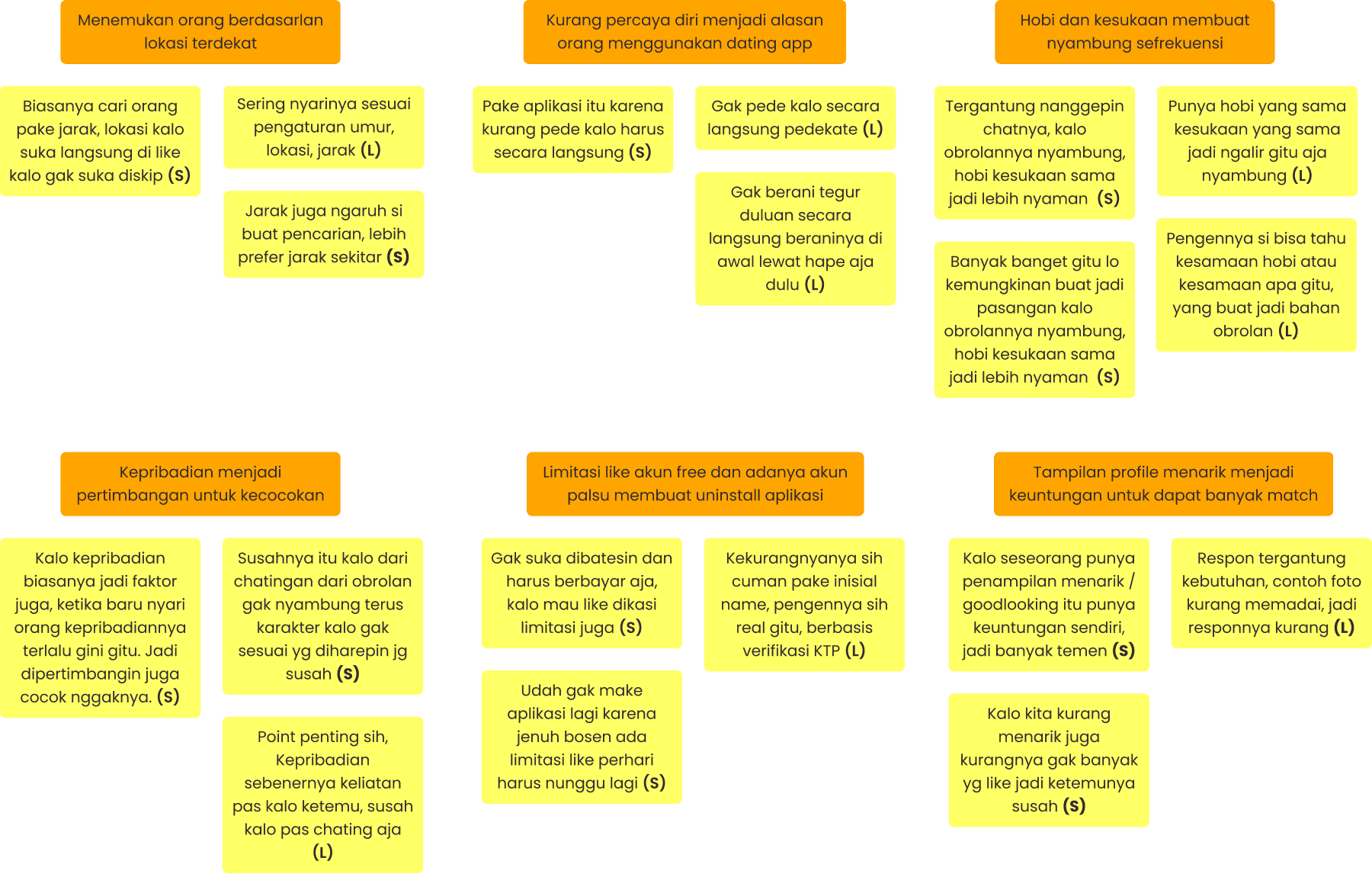
Image: Interim Analysis
How Might We (HMW)
In answering each user problem, we can create How Might We (HMW) questions. We can define these questions by referring to the results of the observation statement in the interim analysis.

Image : How Might We
Building the Foundation
Defining the Solution
Each question that has been defined with How Might We (HMW), then we write down various solutions that we think are ideal or what is called Design Mandates. The solutions that have been made will be the main foundation in creating product features that will be developed.

Image: Design Mandates
Elevator (Twitter) Pitch
Elevator (Twitter) Pitch aims to understand and explain what we are going to create in 30 seconds or less than 200 characters. Simply put, the product or feature that will be created is:
Helping people find friends or partners by matching similar personalities and interests.
User Map Flow
When creating a product as a whole or even a feature, we usually have a simple flow concept that explains how users use or interact with the product/feature to be created.

Image: User Map Flow
Methods of Finding Friends or Partners
In searching for friends or partners on the Temen.in application feature, this is based on account personalization with the same interests/hobbies. And to determine the compatibility recommendations between individuals, namely by synchronizing personality types. This personality synchronization uses the Myers-Briggs Type Indicator method.
Quoted from persona.my.id: 'With MBTI, you can find someone who can complement your personality. You can also better understand the personality of your future partner, starting from their habits, their life goals to what values can make you comfortable with each other'.

Image: Matching Recommendations with MBTI
Looking for Ideas
Crazy Eight
The concept of the idea to be built is guided by the design solution and user map flow that has been created. So that we can find out what concept of ideas we will need in designing the solution. Creating the concept of the idea using the Crazy Eight method, namely by making 8 big idea sketches.

Image: Crazy Eight
Solution Sketch
After creating 8 main big ideas we will develop them into solution sketches. These sketches help us to explore ideas and solutions, without focusing on visual details.

Image: Solution Sketch
Making a Prototype
Prototypes are designed through several stages starting from creating a UI style guide, high-fidelity design to creating an interactive and clickable prototype. Prototype design focuses on the details of typography visualization, color, components, to the interaction between each part. Here are the details of the stages of making a prototype:
UI Style Guide
UI Style Guide defines the rules of each section starting from typography, color, and UI components.
We created this product branding with soft purple and red colors that characterize the tenderness of love.

Image: UI Style Guide
High Fidelity Design
High-fidelity designs are created to better visualize wireframes by paying attention to the design style or UI Style Guide that has been created so that the resulting design looks like a real display.
Onboarding

Image: Hi-Fi Onboarding
Personality Test

Image: Hi-Fi Personality Test
Home & Search

Image: Hi-Fi Home & Search
Matching Recommendations & Profile

Image: Hi-Fi Matching Recommendations & Profile
Chat, Account & Setting

Image : Hi-Fi Chat, Account & Setting
Interactive Prototype
Armed with the existing high-fidelity design, the next step is to create an interactive and clickable prototype by creating interactions between each page, section or component that are related according to the user flow that has been designed.
Here is a preview of the interactive prototype:
Final Notes

Image: Temen.in App Mockup
This case study only produces a prototype that I did as an effort to explore the design, where I made a challenge to create a solution or concept that may not have existed before, namely helping people find friends or partners by matching similar personalities and interests. To measure the extent to which this concept is accepted, it can be followed up with usability testing to get useful feedback to evaluate further.